Bio - Based / Green Solvents, High-Purity Solvents

C8–C10 Alcohols

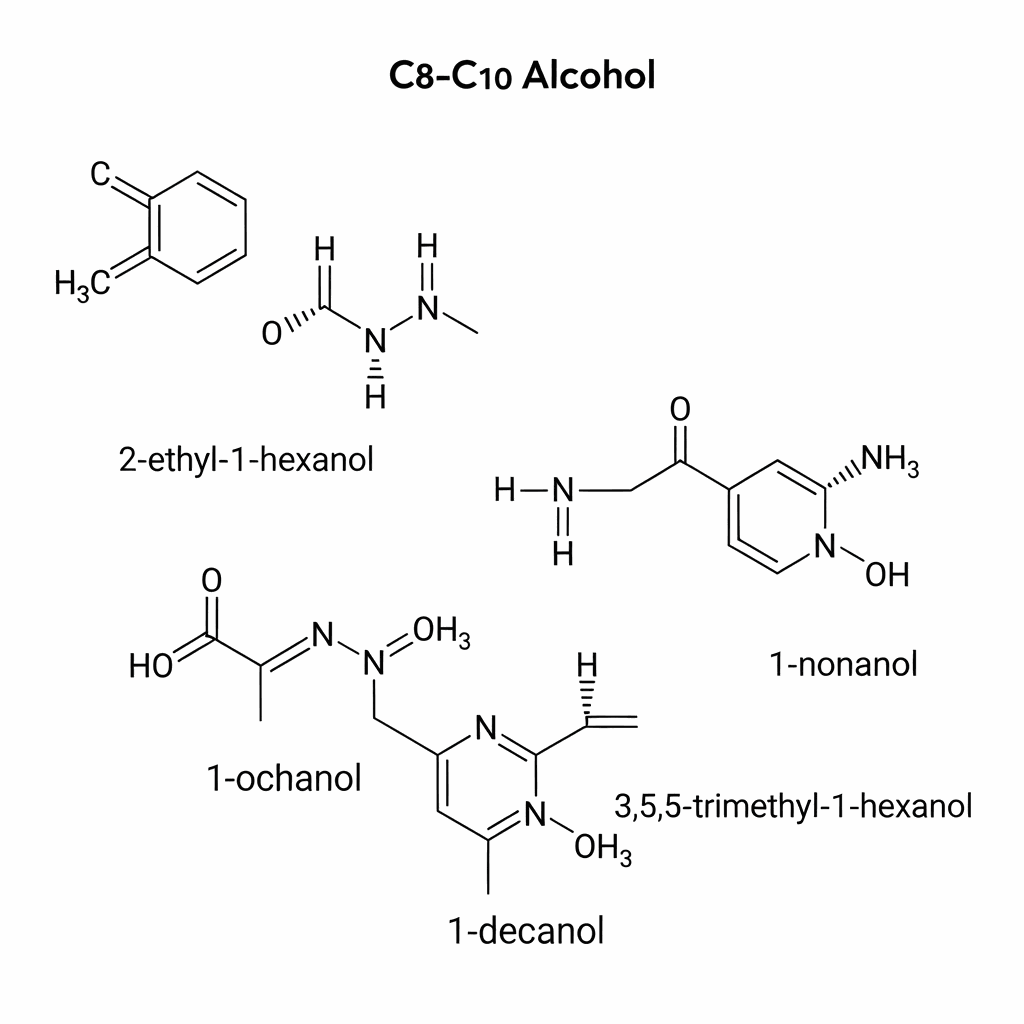
C8–C10 Alcohols, often referred to as linear fatty alcohols or mid-cut detergent alcohols, are clear, colorless, and oily liquids primarily composed of octanol and decanol. These compounds are derived either from natural sources like coconut or palm kernel oil through hydrogenation of fatty acids or synthetically via the Ziegler process or oxo synthesis. Characterized by a mild, fatty odor, these alcohols possess a unique amphiphilic nature, featuring a hydrophobic hydrocarbon chain and a hydrophilic hydroxyl group. This structural duality makes them essential precursors in the production of surfactants and plasticizers. Their physicochemical properties, such as low volatility and excellent solvency, allow them to function as effective intermediates in organic synthesis. These alcohols exhibit high stability under various environmental conditions while maintaining biodegradability, making them preferred choices in green chemistry applications. They serve as critical building blocks for ethoxylates and sulfates, bridging the gap between low-molecular-weight solvents and high-molecular-weight waxes effectively.
Attributes

Key Features and Benefits

  • Excellent solubility in organic solvents and oils, facilitating highly uniform dispersion in diverse liquid chemical formulations.
  • High chemical purity with minimal branched isomers, ensuring extremely predictable reaction kinetics during complex industrial esterification processes.
  • Strong biodegradability profile, aligning perfectly with modern regulatory requirements for environmentally friendly and sustainable chemical intermediates.
  • Low pour point and high flash point significantly enhance handling safety and storage stability across various climates.
  • Dual-chain length distribution optimizes performance in wetting, foaming, and emulsification across multiple demanding industrial sectors and applications.
Specifications

Technical Highlights

  • CAS Number 85566-12-7 represents a blend typically comprising 40-50% Octanol (C8) and 50-60% Decanol (C10).
  • The hydroxyl value typically ranges between 380 and 420 mg KOH/g, indicating high reactivity.
  • Boasting a typical density of 0.82-0.83 g/cm³ at 20°C, the blend is lighter than water.
  • Low moisture content, usually below 0.1%, prevents unwanted side reactions in moisture-sensitive chemical synthesis.
  • Acid value is strictly controlled below 0.1 mg KOH/g to maintain the high quality of derived products.

Download Technical Data Sheet (TDS)

Practical industry uses

Applications

  • Primary feedstock for manufacturing ethoxylated surfactants used in household laundry detergents and industrial cleaners.
  • Key intermediate in the synthesis of phthalate-free plasticizers for polyvinyl chloride (PVC) and other resins.
  • Utilized as an antifoaming agent or defoamer in oilfield operations and paper manufacturing processes.
  • Employed in the fragrance industry as a carrier solvent or precursor for aromatic esters.
  • Serves as a lubricant additive to improve viscosity indices and friction-reducing properties in metalworking fluids.
Key Sectors

Target Industries

Discover more

Related products

Key Sectors

We’re Here to Support Your Chemical Sourcing Needs

Have a question or need a quote? Our team is here to help with product details, pricing, and global delivery options.

Send a message to us

Your email address will not be published. Required fields are marked *