High-Purity Solvents, Polyurethane (PU) and Resin

Dimethylformamide (DMF)

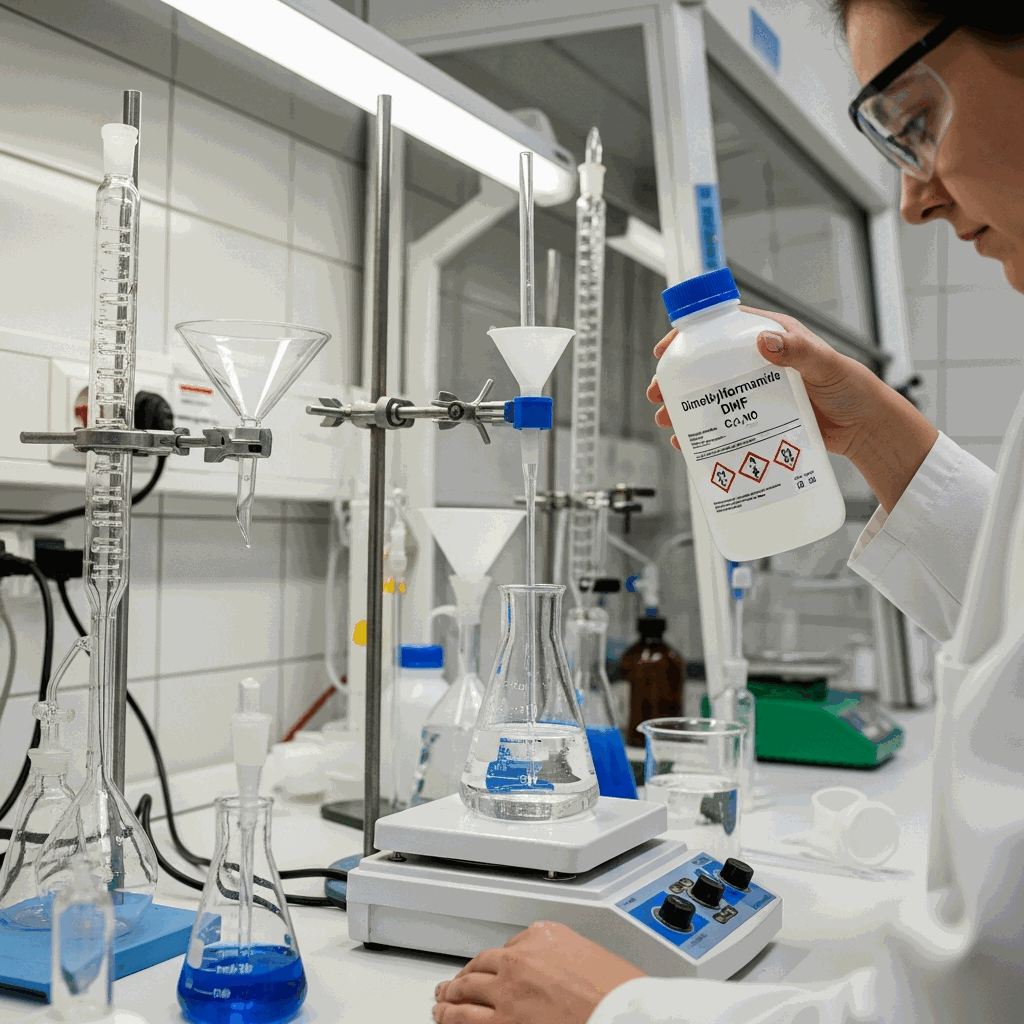
N,N-Dimethylformamide (CAS: 68-12-2), commonly abbreviated as DMF, is a clear, colorless, and hygroscopic liquid that serves as a cornerstone in modern industrial chemistry. Characterized by a faint, amine-like odor, it is a high-boiling polar aprotic solvent. Structurally, it is the dimethyl derivative of formamide (HCON(CH3)2). DMF is frequently referred to as the “universal solvent” due to its extraordinary ability to dissolve a wide spectrum of both organic and inorganic compounds. Its high dielectric constant and chemical stability make it an ideal medium for reactions involving ionic mechanisms, such as nucleophilic substitutions. While its performance is unparalleled in applications ranging from fiber spinning to pharmaceutical synthesis, DMF is strictly regulated due to its classification as a reprotoxic substance and its high rate of dermal absorption. Consequently, industrial use demands rigorous adherence to Safety Data Sheet (SDS) protocols and the implementation of closed-loop recovery systems.
Attributes

Key Features and Benefits

  • Exceptional Solvency: Dissolves a vast range of polymers (e.g., polyurethanes, polyacrylonitriles) and resins that are insoluble in standard organic solvents.
  • Polar Aprotic Character: Enhances the reactivity of anions in SN2 reactions by solvating cations, leading to faster reaction kinetics and higher yields.
  • High Thermal Stability: Remains stable at elevated temperatures, permitting reactions that require sustained heat without solvent degradation.
  • Universal Miscibility: Completely miscible with water and most common organic solvents, providing immense flexibility in complex formulation and extraction processes.
  • Low Vapor Pressure: Minimizes atmospheric emissions and evaporative loss at room temperature compared to low-boiling solvents like acetone or DCM.
  • Industrial Recyclability: Can be efficiently recovered via vacuum distillation, improving the cost-effectiveness and sustainability of large-scale manufacturing.
Specifications

Technical Highlights

  • Molecular Formula: C3H7NO (Molar Mass: 73.09 g/mol).
  • Boiling Point: 153°C (307°F) at 760 mmHg, offering a broad liquid phase range.
  • Flash Point: 58°C (136°F) (Closed Cup); categorized as a combustible liquid.
  • Dielectric Constant: 36.7 (at 25°C), facilitating excellent ion stabilization.
  • Viscosity: 0.802 mPa·s at 25°C, ensuring ease of pumping and filtration in industrial lines.
  • Solubility Parameter: High Hansen Solubility Parameter (δp = 13.7, δh = 11.3), indicating strong polar and hydrogen-bonding capabilities.
  • Auto-ignition Temperature: 445°C (833°F).

Download Technical Data Sheet (TDS)

Practical industry uses

Applications

  • Synthetic Fibers & Plastics: Primary solvent for the wet spinning of acrylic fibers and the production of polyurethane-based synthetic leathers and coatings.
  • Pharmaceutical Synthesis: Essential for the production of Active Pharmaceutical Ingredients (APIs), serving as a reaction medium and a solvent for purification and crystallization.
  • Electronics Industry: Used as a cleaning agent for printed circuit boards and a solvent in the manufacturing of high-purity semiconductors and photoresists.
  • Agrochemicals: Utilized in the formulation and synthesis of various pesticides, herbicides, and fungicides.
  • Petrochemical Processing: Employed in the extractive distillation of butadiene and the recovery of aromatics from hydrocarbon streams.
  • Organic Reagent: Acts as a chemical intermediate in the Vilsmeier-Haack reaction for the formylation of aromatic compounds.
Key Sectors

Target Industries

Discover more

Related products

Key Sectors

We’re Here to Support Your Chemical Sourcing Needs

Have a question or need a quote? Our team is here to help with product details, pricing, and global delivery options.

Send a message to us

Your email address will not be published. Required fields are marked *