Dipropylene Glycol Dimethyl Ether
Glycol Ethers, High-Purity Solvents

Dipropylene Glycol Dimethyl Ether

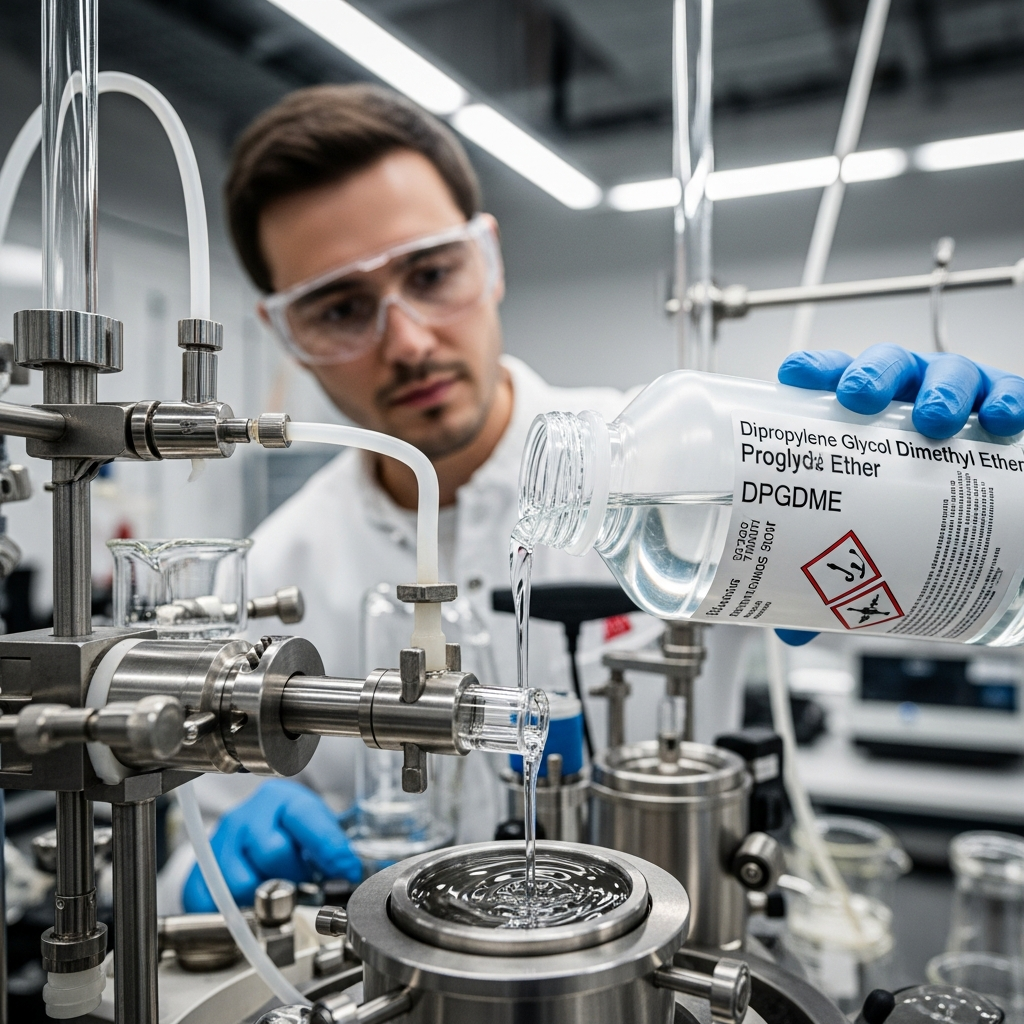
Dipropylene Glycol Dimethyl Ether (DPGDME), commercially known under trade names such as Proglyde™ DMM, is a versatile, colorless, and low-toxicity organic solvent characterized by its aprotic nature. Unlike standard glycol ethers, DPGDME is a “capped” glycol ether, meaning both terminal hydroxyl groups are replaced by methoxy groups. This lack of reactive hydroxyl functionality makes it chemically inert and exceptionally stable in highly alkaline or acidic environments where traditional alcohols would degrade or react.

Technically, it is a mixture of isomers (CAS 111109-77-4) that offers an excellent balance between volatility and solvency. It bridges the gap between polar and non-polar substances, acting as a powerful coupling agent in complex formulations. Due to its favorable toxicological profile and high flash point compared to lower molecular weight ethers, it is increasingly favored as a more sustainable, non-HAP (Hazardous Air Pollutant) alternative to traditional solvents like NMP or glycol ether acetates in high-performance industrial applications.

Attributes

Key Features and Benefits

**Aprotic Structure:** The absence of active hydrogen atoms makes it compatible with reactive chemistry, such as isocyanates in polyurethane systems.
**High Solvency Power:** Effectively dissolves a wide range of resins, including acrylics, epoxies, polyurethanes, and alkyds.
**Excellent Stability:** Demonstrates superior hydrolytic stability, allowing for use in waterborne formulations without the risk of pH drift or chemical breakdown.
**Safety Profile:** Not classified as a HAP or a SARA 313 regulated substance; it features low acute toxicity and is generally mild on skin contact.
**Coupling Efficiency:** Acts as an bridge-solvent, facilitating the blending of water with oil-soluble components in stable emulsions.
**Low Odor:** Provides a comfortable working environment for indoor industrial applications.

Specifications

Technical Highlights

**Molecular Formula:** $C_8H_{18}O_3$
**Molecular Weight:** 162.23 g/mol
**Boiling Point:** 175°C (347°F) at 760 mmHg
**Flash Point (Closed Cup):** 65°C (149°F), classifying it as a combustible liquid rather than flammable in many jurisdictions.
**Vapor Pressure:** 0.55 mmHg at 20°C, indicating a medium-to-slow evaporation rate for controlled film formation.
**Specific Gravity:** 0.902 at 25°C.
**Viscosity:** 1.0 cP at 25°C, offering low-viscosity thinning capabilities.
**Solubility:** Completely miscible in water (100% at 25°C) and most organic solvents including alcohols, ketones, and aliphatic hydrocarbons.
**Log P (Octanol/Water):** 0.42, highlighting its balanced amphiphilic nature.

Download Technical Data Sheet (TDS)

Practical industry uses

Applications

• Electrical and electronics
• Connectors, switches, PCB housings, terminal blocks
• Automotive
• Under-hood components, interior assemblies, cable conduits
• Wire and cable
• Insulation layers, sheathing, jacketing materials
• Construction
• Plastic fittings, conduits, insulation panels
• Consumer appliances
• Enclosures, adapters, plugs, casings
• Industrial components
• Fiber-reinforced composites, flame-retardant masterbatches
• Compatible polymers
• PA6, PA66
• PBT, PET
• PE, PP
• Blends and copolymers requiring halogen-free flame retardancy

Key Sectors

Target Industries

Discover more

Related products

Key Sectors

We’re Here to Support Your Chemical Sourcing Needs

Have a question or need a quote? Our team is here to help with product details, pricing, and global delivery options.

Send a message to us

Your email address will not be published. Required fields are marked *