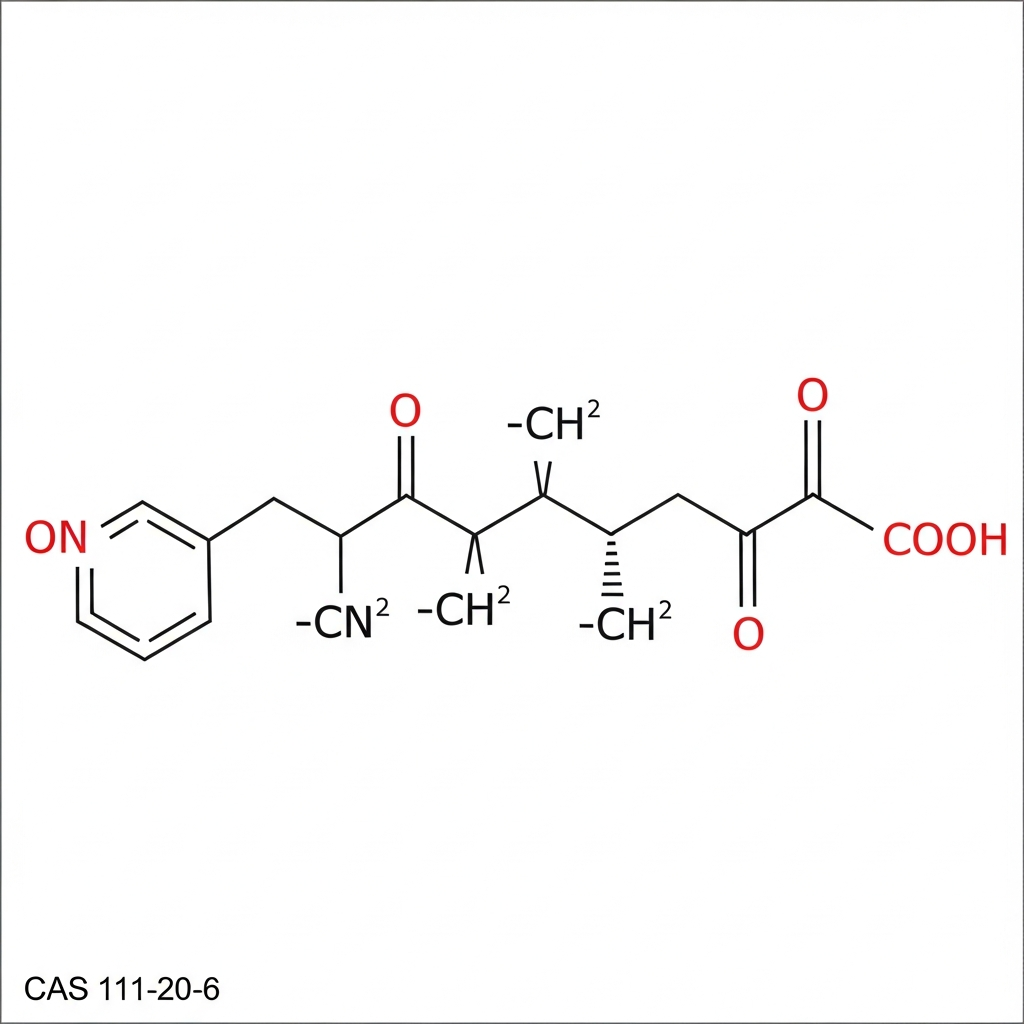
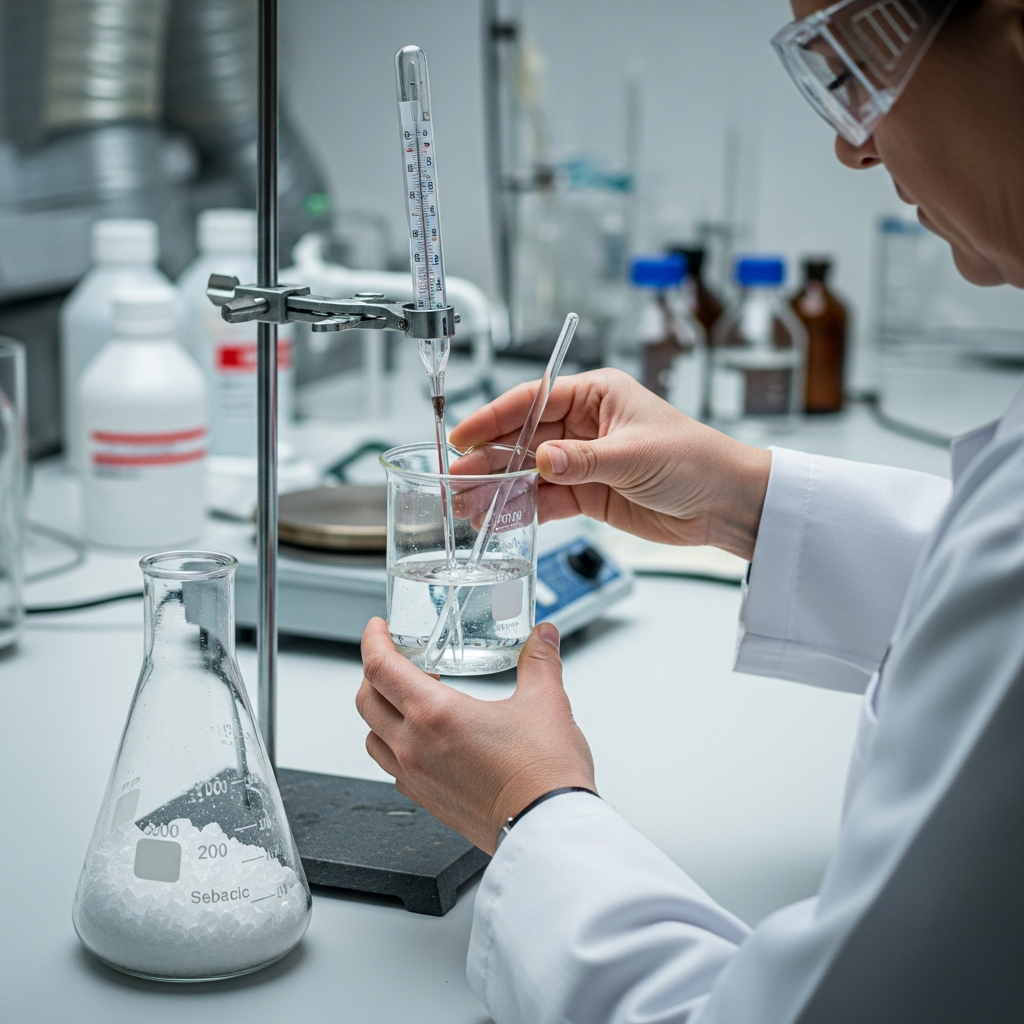
Sebacic acid, chemically identified as decanedioic acid (CAS: 111-20-6), is a naturally occurring, straight-chain saturated dicarboxylic acid with the molecular formula $C_{10}H_{18}O_{4}$. It is predominantly synthesized through the alkaline cleavage of ricinoleic acid, which is derived from castor oil—a renewable, bio-based feedstock. This origin makes sebacic acid a vital component in the shift toward “green” and sustainable chemistry.
Appearing as a white crystalline powder or flake, it is characterized by its two terminal carboxylic acid groups separated by an eight-carbon aliphatic chain. This structure imparts unique properties, including high thermal stability, excellent flexibility, and hydrophobicity. In the industrial sector, it serves as a versatile intermediate for the production of high-performance polymers, lubricants, and plasticizers. Its ability to undergo precise esterification and polymerization makes it indispensable in the manufacturing of specialty nylons and biodegradable resins, bridging the gap between agricultural resources and advanced material science.
**Renewable Feedstock:** Produced from castor oil, offering a reduced carbon footprint compared to petroleum-derived alternatives.
**Superior Flexibility:** The long $C_{10}$ carbon chain provides exceptional impact resistance and low-temperature flexibility in finished polymers.
**Thermal and Oxidative Stability:** Demonstrates high resistance to degradation at elevated temperatures, extending the lifespan of industrial products.
**Hydrophobic Nature:** Its aliphatic structure provides better water resistance than shorter-chain dicarboxylic acids like adipic acid.
**Non-Toxic Profile:** Generally regarded as safe (GRAS) for specific applications, facilitating its use in cosmetics and sensitive consumer goods.
**Bifunctional Reactivity:** Dual carboxylic groups allow for the synthesis of complex esters and linear long-chain polyamides.
**Molecular Weight:** 202.25 g/mol.
**Melting Point:** Typically ranges from 131°C to 134.5°C, ensuring stability during high-heat processing.
**Acidity (pKa):** Bifunctional acid with $pKa_1 approx 4.59$ and $pKa_2 approx 5.59$ at 25°C.
**High Purity:** Available in commercial grades exceeding 99.5% purity, critical for polymerization to achieve high molecular weights.
**Solubility:** Low solubility in water ($1.0$ g/L at 20°C); highly soluble in ethanol, ether, and organic solvents.
**Flash Point:** Approximately 220°C (open cup), providing a high safety margin in industrial manufacturing environments.
**Vapor Pressure:** Extremely low ($1.58 times 10^{-6}$ mmHg at 25°C), minimizing volatile emissions.
• Electrical and electronics
• Connectors, switches, PCB housings, terminal blocks
• Automotive
• Under-hood components, interior assemblies, cable conduits
• Wire and cable
• Insulation layers, sheathing, jacketing materials
• Construction
• Plastic fittings, conduits, insulation panels
• Consumer appliances
• Enclosures, adapters, plugs, casings
• Industrial components
• Fiber-reinforced composites, flame-retardant masterbatches
• Compatible polymers
• PA6, PA66
• PBT, PET
• PE, PP
• Blends and copolymers requiring halogen-free flame retardancy


Have a question or need a quote? Our team is here to help with product details, pricing, and global delivery options.
Your email address will not be published. Required fields are marked *