High-Purity Solvents, Personal Care

N,N-Dimethyldodecylamine

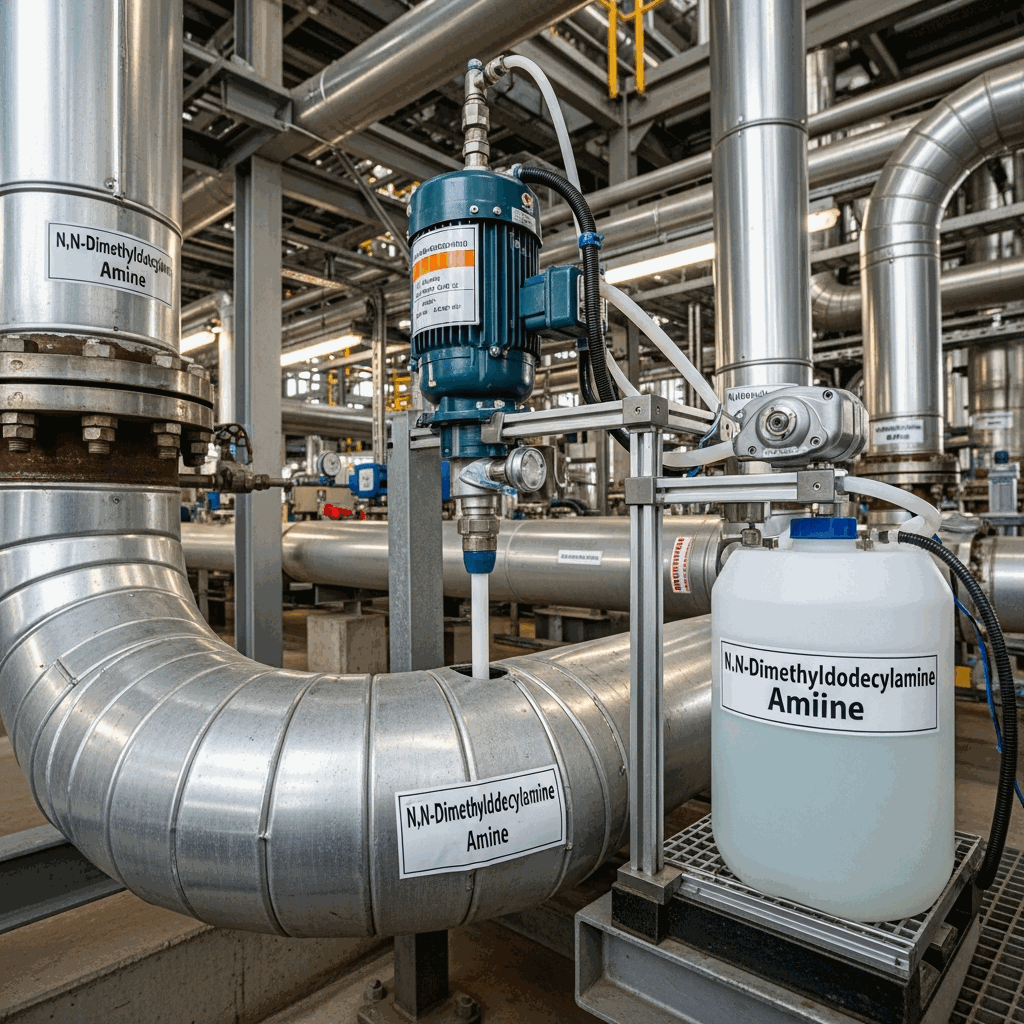
N,N-Dimethyldodecylamine (CAS: 112-18-5), commonly known as Dimethyllaurylamine or DML, is a tertiary fatty amine characterized by a twelve-carbon (C12) linear alkyl chain bonded to a dimethyl-substituted nitrogen atom. As a clear to pale yellow liquid with a characteristic amine odor, it serves as a critical intermediate in the specialty chemical industry. Its molecular structure—combining a hydrophobic paraffinic tail with a reactive tertiary amine head—enables its use as a foundational building block for a wide array of surfactants. It is synthesized primarily through the catalytic hydroamination of dodecyl alcohol or the reaction of dodecyl chloride with dimethylamine. While primarily valued for its role in synthesizing quaternary ammonium compounds and amine oxides, it also possesses inherent antimicrobial and corrosion-inhibiting properties. Due to its alkaline nature and surfactant characteristics, it is classified as corrosive and hazardous to aquatic environments, requiring stringent handling and containment protocols in industrial settings.
Attributes

Key Features and Benefits

  • High Synthesis Versatility: The tertiary amine functional group undergoes efficient quaternization and oxidation, making it an ideal precursor for cationic and amphoteric surfactants.
  • Excellent Lipophilicity: The $C_{12}$ alkyl chain provides a perfect balance of oil solubility and surface activity, essential for effective emulsification.
  • Film-Forming Capability: It readily adsorbs onto metallic surfaces, creating a molecular barrier that provides significant corrosion protection in acidic media.
  • Thermal Stability: Exhibits robust chemical stability across a wide temperature range, ensuring reliability during high-temperature industrial processing.
  • Precursor to Biodegradables: Derivatives produced from this amine, such as amine oxides, are noted for their excellent biodegradability and low toxicity profile in consumer end-products.
Specifications

Technical Highlights

  • Molecular Formula: $C_{14}H_{31}N$ or $CH_3(CH_2)_{11}N(CH_3)_2$.
  • Molecular Weight: 213.40 g/mol.
  • Physical Properties: Boiling point of approximately 247–250°C; Flash point $approx$ 105°C (Closed Cup).
  • Solubility Profile: Insoluble in water; highly miscible with organic solvents including ethanol, chloroform, and diethyl ether.
  • Amine Value: Typically ranges from 260 to 265 mg KOH/g, indicating high purity and reactive nitrogen content.
  • Safety Classification: Categorized under GHS as Corrosive (Skin Corr. 1B), Acute Oral Toxicity (Cat 4), and Very Toxic to aquatic life (Aquatic Acute/Chronic 1).
  • Specific Gravity: Approximately 0.78–0.80 at 20°C.

Download Technical Data Sheet (TDS)

Practical industry uses

Applications

  • Surfactant Manufacturing: The primary raw material for Lauryl Dimethyl Amine Oxide (LDAO) and Benzalkonium Chloride, used extensively in household cleaners and disinfectants.
  • Personal Care Products: Used to synthesize alkyl betaines and amine oxides that function as foam stabilizers, thickeners, and conditioning agents in shampoos and body washes.
  • Oilfield Chemicals: Applied as a corrosion inhibitor in downhole operations and as a formulation component for drilling muds and acidizing stimulants.
  • Water Treatment: Serves as an intermediate for quaternary biocides and algaecides used in industrial cooling towers and swimming pools.
  • Textile and Leather: Utilized as a dye-leveling agent, antistatic additive, and softening agent during fiber processing.
Key Sectors

Target Industries

Discover more

Related products

Key Sectors

We’re Here to Support Your Chemical Sourcing Needs

Have a question or need a quote? Our team is here to help with product details, pricing, and global delivery options.

Send a message to us

Your email address will not be published. Required fields are marked *